

The answer is that you will know how long it takes to learn how to surf when you can paddle out independently, read a wave, and ride a green wave to shore with basic control. By that standard, most committed beginners reach it in eight to fifteen sessions. Daily surfing gets you there faster than once a week. Coaching gets you there faster than self-teaching.
| Learning context | Time to first green wave |
|---|---|
| Daily surf camp with coaching (CARI) | Days: 3–4 |
| Daily surfing, self-taught | Sessions: 6–10 |
| 3× per week with coaching | Weeks: 2–3 |
| 1–2× per week, self-taught | Sessions: 10–20+ |
These are honest averages. The CARI number reflects what we see across all beginner guests — not the fast learners, not the exceptions. Every guest. The difference is daily sessions, consistent coaching, and video analysis from day one.
– In this Article
- How Long Does It Take To Learn Surfing?
- What is Most Beneficial to Learn How To Surf?
- Beginner Progress Timeline
- What You Can learn in one lesson
- What you can learn in one week
- What you can learn in one month
- Why some people progress faster
- How coaching speeds up learning
- Realistic expectations for Bali
What is Most Beneficial to Learn How To Surf?
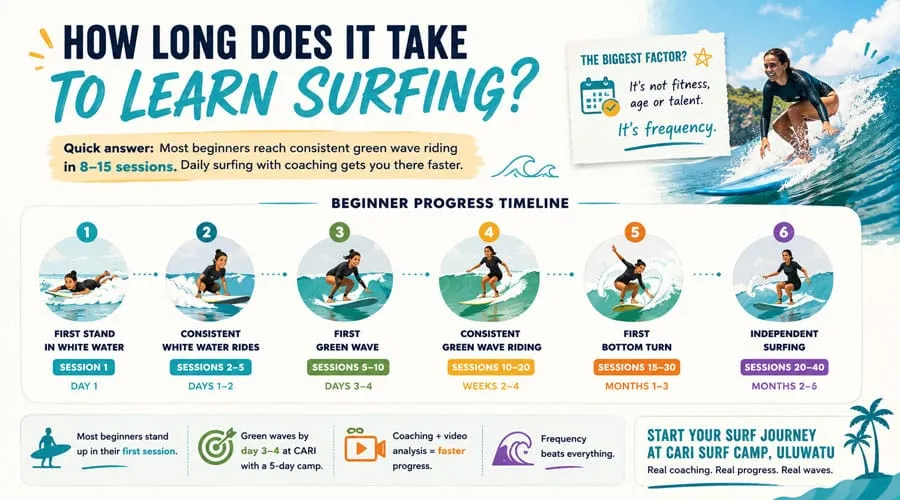
Most beginners stand up in their first session. Consistent, controlled riding of green waves takes eight to fifteen sessions for the average person. Daily surfing in a structured camp compresses that significantly. At CARI Surf Camp in Uluwatu, every beginner guest catches their first green wave within a five-day programme — most by day three or four.
The single biggest variable is not fitness, not age, and not athletic background. It is how often you surf.
Surfing is one of the few sports where the first milestone arrives fast and the second takes longer than expected. Standing up in white water on session one is common. Actually surfing — reading a wave, paddling into position, popping up on a green wave, and riding the face with control — takes most people eight to fifteen sessions. The gap between those two things catches a lot of beginners off guard.
We have coached hundreds of beginners at CARI Surf Camp in Uluwatu, Bali. The patterns are consistent enough to give you honest numbers.
“White water is not remedial. It is where technique is set.”
Yudis, Team Leader – Surf Coach at CARI Surf Camp
Beginner Progress Timeline
| Milestone | Average sessions | With CARI daily programme |
|---|---|---|
| First stand in white water | Session 1 | Day 1 |
| Consistent white water rides | Sessions 2–5 | Days 1–2 |
| First green wave | Sessions 5–10 | Days 3–4 |
| Consistent green wave riding | Sessions 10–20 | Weeks 2–4 |
| First bottom turn | Sessions 15–30 | Months 1–3 |
| Independent surfing | Sessions 20–40 | Months 2–6 |
These are averages. Some guests catch their first green wave on day two. Some take longer. The biggest predictor is not fitness, not age, and not natural athletic ability. It is how many sessions happen in a short window. Frequency beats everything else.
What You Can learn in one lesson
A single lesson, done well, achieves more than most people expect and less than they hope.
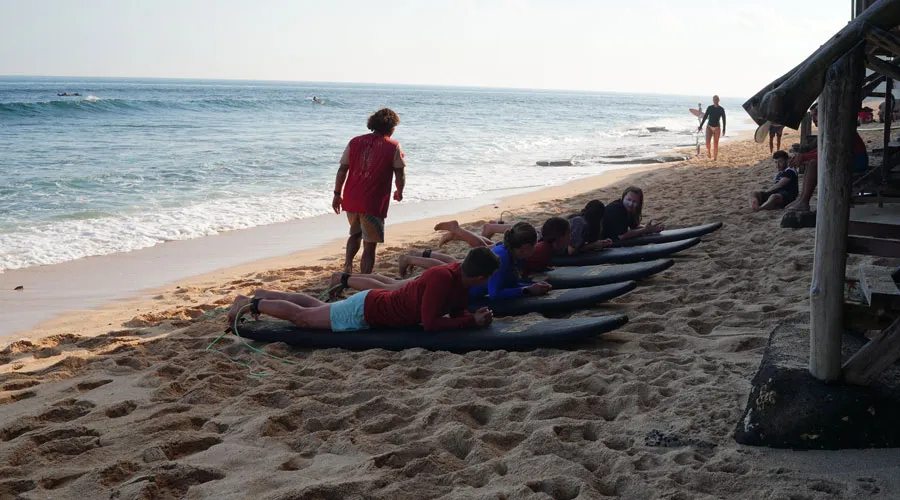
What is realistic in one lesson. Most first-time surfers stand up at least once in white water during a ninety-minute session. The mechanics of lying on the board, paddling, and attempting the pop-up are all learnable in one go. Ocean awareness, basic water safety, and the rules of a surf break all get covered in the pre-water briefing.
What is not realistic in one lesson. Control, consistency, or anything on a green wave. One lesson builds familiarity with the equipment and the motion. It does not build the muscle memory that makes surfing feel natural. That takes repetition.
The most common problem with single lessons is leaving with a false read on how close you are to actually surfing. Standing up once in slow white water is step one of a long staircase. That framing saves a lot of people from unnecessary frustration in sessions two and three.
What you can learn in one week
One week is where real progress happens — provided you are in the water every day.
Sessions one and two are about white water: paddle timing, body position, pop-up consistency. By the end of day two, most guests at CARI can ride white water with reasonable control and are starting to select waves rather than just reacting to them.
Sessions three and four are when green waves become realistic. The pop-up has enough repetition behind it to feel less like a thought and more like a reflex. Wave reading starts to click. This is the session most guests identify as the turning point of the week.
Session five is consolidation. Green wave catches become more consistent. Positioning in the line-up starts to make sense. The body has adapted to paddling. At this point most beginners feel like they are surfing rather than just surviving.
One week of daily surfing with coaching takes most beginners from zero to catching green waves. One week of drop-in lessons two or three days apart typically gets them to consistent white water and occasionally a first green wave. The daily version produces noticeably better results.
What you can learn in one month
One month with consistent surfing changes the experience entirely. The difference between a beginner with one week of experience and one with a month is not incremental. It is a different category of surfer.
In one month surfing three or more times per week, most people reach a point where white water feels easy and green waves feel manageable. They start to understand how wave shape affects what is possible on a ride. The pop-up stops being a conscious process and starts being automatic.
The next skills that become visible in this window are basic wave selection at the line-up, the ability to angle the board on a wave face, and the early stages of a bottom turn. None of these are reliable yet. But they are there.
What also happens in the first month is the first plateau. Around sessions eight to twelve, many surfers feel like they have stopped improving. They are catching waves but not progressing. This is normal and predictable. The transition from catching green waves to riding them with control is the hardest gap to close without coaching — because the errors holding you back are impossible to see from inside your own surfing. This is where video analysis changes everything.
DID
YOU
SURF
TODAY?
Why some people progress faster
Frequency beats everything. Three sessions in one day teaches more than three sessions spread across three weeks. The body and brain retain what they practise. Gaps between sessions mean you spend the first thirty minutes of each one rediscovering what you already knew. Daily surfing compounds in a way that weekly surfing cannot replicate.
Willingness to stay in white water longer than feels necessary. This is the counterintuitive one. Guests who push onto green waves before their pop-up is automatic consistently plateau sooner than those who build a solid foundation in white water first. White water is not remedial. It is where technique is set. Rushing past it is the most common cause of slow progress in surfers who have been at it for months.
Coachability beats fitness. The guests who progress fastest at CARI are not the fittest or the most athletic. They are the ones who take specific feedback and implement it in the water immediately. Surfing is a technical sport. Physical fitness helps with paddling endurance. It does not determine how quickly you learn to read a wave or time a pop-up.
Balance sports help less than people expect. Guests with yoga, skateboarding, or snowboarding backgrounds often pop up faster in the first two sessions. By session five that advantage has largely disappeared. Surfing balance is specific and has to be learned on a surfboard in the ocean.
How coaching speeds up learning
Self-teaching surfing is possible but slow. The reason is specific: the most important corrections in surfing are invisible to the person making the error.
A late pop-up feels like a timing problem. From outside the water it is visually obvious. A wide stance looks and feels normal to the person doing it. On video it is immediately apparent. Looking down at the board feels like concentration. On footage it is clearly what is preventing the ride from continuing.
Most beginners spend months developing habits that a single video review session could have prevented in week one.
At CARI, every session includes video analysis. We film every wave every guest rides, review the footage on the beach or back at camp, and give specific technical feedback for the next session. The four errors that appear most consistently on video:
- Pop-up initiated too late
- Eyes looking at the board rather than down the wave
- Chest not fully raised off the board
- Back foot too far forward on the board
These are not things you can feel while you are surfing. They are things you can only see. If you are surfing without coaching, recording yourself and watching it back honestly does most of the same work.
Realistic expectations for Bali
Bali compresses the surfing learning curve because you can surf every day in warm water with consistent beginner waves. That context matters more than most people realise before they arrive.
In a five-day camp at CARI, guests with zero experience routinely reach green waves by day three or four. In a ten-day stay with daily surfing, guests move from catching green waves to riding wave faces with basic control. In a month, a committed beginner in Bali can cover what takes six months surfing once a week at a cold-water beach with infrequent conditions.
What Bali does not change is the fundamental order of progression. White water before green waves. Catching before turning. Foundation before manoeuvres. The timeline compresses. The sequence does not.
The other thing Bali cannot shortcut is the plateau. It happens regardless of location. The difference is that in Bali, with daily coaching and video analysis, you have the tools to push through it in days rather than spending months wondering why progress has stalled.
For a detailed breakdown of what a week of beginner surfing in Bali actually looks like, see our guide on learning to surf in one week and our beginner surf camp page.
Frequently Asked Questions
How many lessons does it take to learn surfing?
Eight to fifteen sessions is the realistic range for most beginners to reach consistent green wave riding with basic control. Daily sessions in a structured camp get you there faster than spread-out lessons. One lesson introduces you to the motion and gives you a foundation — it does not teach you to surf. The milestone that matters is your first green wave, and for most people that arrives somewhere between sessions five and ten.
Can I learn surfing in a week?
In one week of daily surfing with coaching, most beginners with zero experience progress from white water to catching their first green waves. That is a genuine milestone and the most significant threshold in the surfing learning curve. It is not the same as being able to surf independently, but it is where the experience shifts from trying to survive to actually riding waves.
Is surfing hard to learn?
The first stage — standing up in white water — is accessible. Most people manage it in session one. The harder part is the transition to green waves, which requires wave reading, paddle timing, and a reliable pop-up to work together at the same time. Surfing is not technically complicated, but it requires more sessions to feel natural than most beginners expect before they try it.
How often should beginners surf?
As often as possible, especially in the first month. Daily surfing produces dramatically faster progress than surfing once or twice a week. Three sessions per week is the minimum for consistent forward progress without significant relearning between sessions. The first month is where frequency matters most — that is when muscle memory for the pop-up and paddle timing is being built.
When will I catch unbroken waves?
Most beginners catch their first green wave somewhere between sessions five and ten, assuming regular surfing with coaching. At CARI Surf Camp, every beginner guest catches their first green wave within a five-day programme — most by day three or four. Without coaching or without daily sessions, that milestone typically arrives later, around sessions eight to twelve.