

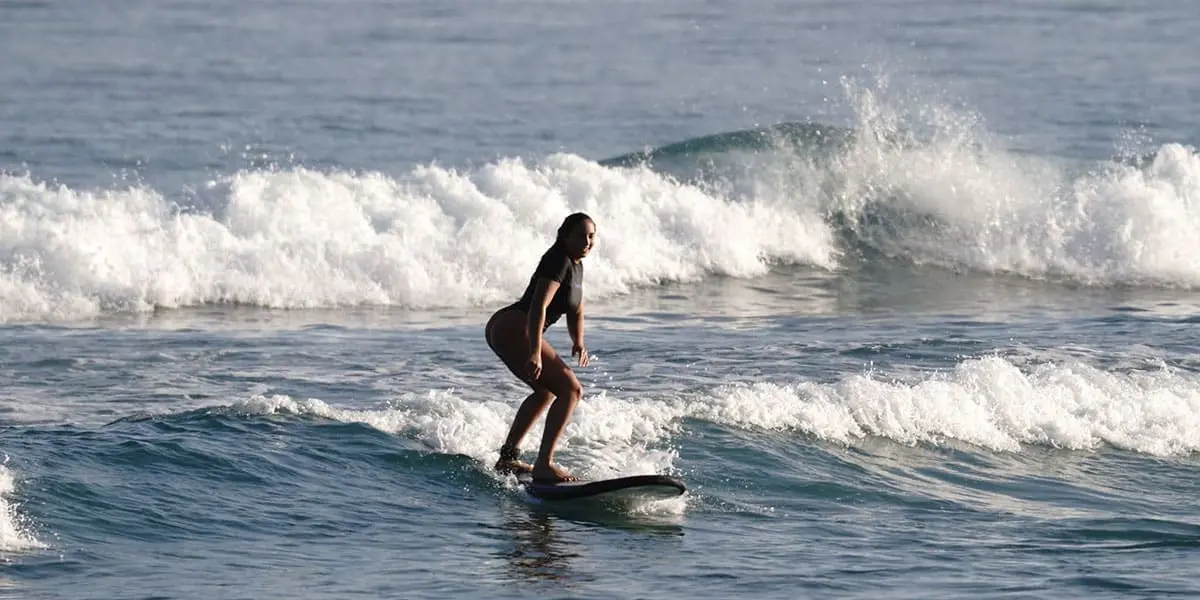
Yes — every single guest who completes a beginner week at CARI Surf Camp will learn surfing in one week. Not most guests. Not the athletic ones. All of them!
That is not a marketing line. It is the outcome of a structured daily programme, an instructor who stays in the water with you, and video analysis of every wave you ride. One week is enough time to go from never having stood on a board to riding unbroken waves with confidence — if the structure around you is right.
Here is exactly what that week looks like.
– In this Article
- Can I Learn Surfing In One Week?
- What You Can Realistically Learn In 7 Days
- Day By Day — The CARI Beginner Progression
- What Makes Progress Faster
- What Slows Beginners Down
- Why Uluwatu — Not Kuta, Not Canggu
- How CARI’s Structure Turns 7 Days Into Real Skills
What You Can Realistically Learn In 7 Days
One week of daily surfing with proper instruction produces a predictable result: you will stand on a board, read a wave, and ride it. You will not be surfing overhead barrels. But the gap between „complete beginner“ and „surfer“ closes faster than most people expect.
By the end of day 2, you will understand ocean safety, paddle with control, and ride whitewater consistently on a soft-top board. The pop-up will feel awkward — that is normal.
By the end of day 4, the pop-up becomes automatic. You stop reacting to waves and start positioning yourself for them. This is where the shift begins.
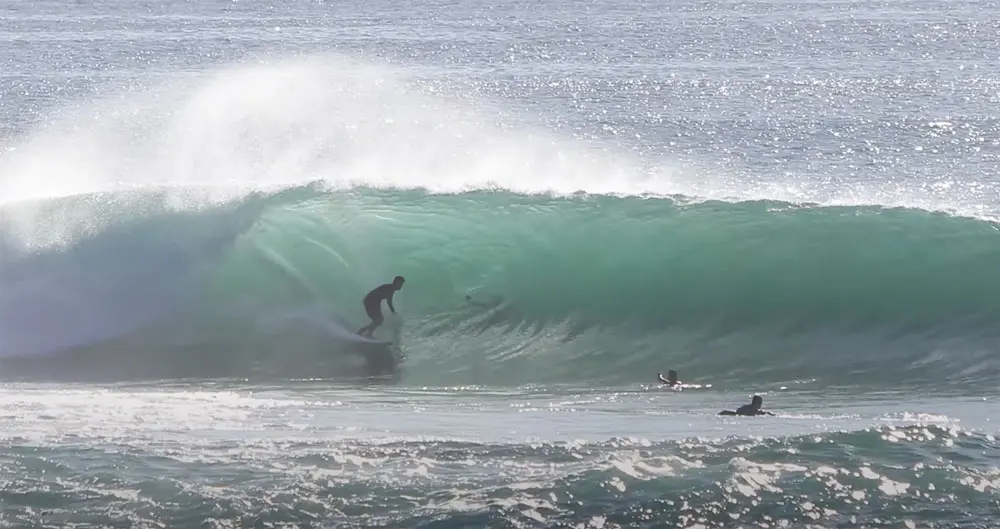
By the end of day 7, you ride green waves. Unbroken, open-face waves — the ones that count. You understand right versus left, how to angle your board, and how to fall safely. You leave with a foundation you can build on independently.
“All of my students make it safely to their feet within one week.”
Yudis, Team Leader – Surf Coach at CARI Surf Camp
Day By Day — The CARI Beginner Progression
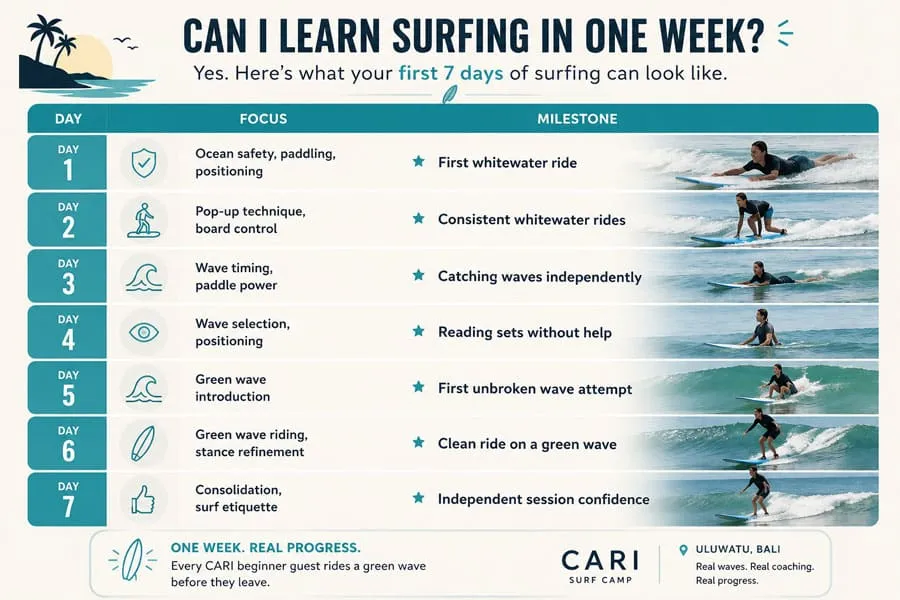
Progress is not perfectly linear — some days feel like a step back. That is a normal part of motor learning, not a sign that something is wrong. What the table below reflects is the consistent trajectory we see across all CARI beginner guests.
The turning point is almost always the same moment: when a guest stops fighting the wave and starts moving with it. Before that click, surfing feels like a struggle against the ocean. After it, the wave does half the work.
| Day | Focus | Milestone |
|---|---|---|
| Day 1 | Ocean safety, paddling, positioning | First whitewater ride |
| Day 2 | Pop-up technique, board control | Consistent whitewater rides |
| Day 3 | Wave timing, paddle power | Catching waves independently |
| Day 4 | Wave selection, positioning | Reading sets without help |
| Day 5 | Green wave introduction | First unbroken wave attempt |
| Day 6 | Green wave riding, stance refinement | Clean ride on a green wave |
| Day 7 | Consolidation, surf etiquette | Independent session confidence |
What Makes Progress Faster
Daily water time. Surfing every day for one week builds neurological patterns that three sessions spread across a month cannot. Frequency beats duration every time when you are learning a new motor skill.
The right board. Beginners on a 9-foot soft-top foam board learn faster than beginners on a shortboard. More volume means more stability, more time to commit to the pop-up, more waves caught. Do not let ego push you onto a small board in week one.
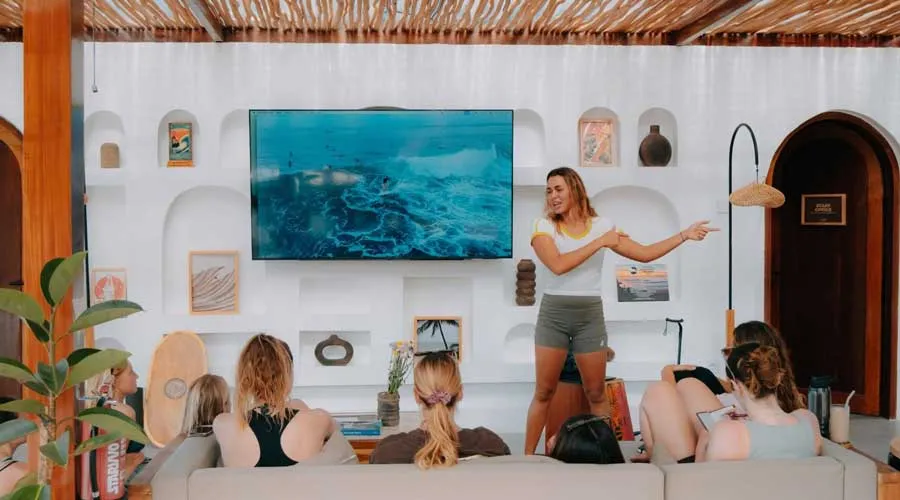
Video feedback on every wave. At CARI, every wave every guest rides is filmed. The most common mistake we see — incorrect foot positioning after the pop-up — is almost invisible to the surfer in the moment. Showing it on video, then fixing it in the water the same session, closes the feedback loop within minutes, not days.
Previous balance sports help — but are not required. Guests who come from skateboarding, snowboarding, or wakeboarding tend to adopt the pop-up faster. That said, complete beginners with no board sport background achieve the same result. It may take an extra session to get there.
What Slows Beginners Down
Fear of the ocean. Legitimate and common. The right response is not to push through it — it is to start in whitewater, build confidence there, and move further out only when it feels right. Instructors who rush this create anxiety, not progress.
Inconsistent practice. Three lessons spread across a week produces a fraction of the progress of daily sessions. Volume is not optional when you are building a new physical skill from scratch.
The wrong equipment. Renting a shortboard because it looks good is one of the most reliable ways to have a frustrating week. Bigger boards catch more waves. More waves mean more practice. More practice means faster progress.
Trying to stand up slowly. The pop-up is one explosive movement. Guests who try to rise from their knees or step through create habits that take weeks to unlearn. Learning the correct movement on day one saves significant time later — which is why we drill it on land before anyone enters the water.
Why Uluwatu — Not Kuta, Not Canggu
Most Bali surf advice tells beginners to go to Kuta. It is not wrong — Kuta has gentle beach break waves and is genuinely good for learning. But it is not where you come to feel what surfing actually is.
Uluwatu is different. It is where surfing culture in Bali began — and that history is present in everything: the cliffs, the breaks, the people in the water, the way life is organised around the tides. Staying at CARI in Uluwatu is not a tourist experience. It is the feeling of becoming part of a culture that grew up around surfing.
That is difficult to put into words precisely because it is not a feature — it is a feeling. Guests who have surfed in Kuta and then spent a week in Uluwatu consistently describe the difference as something they did not expect and could not have read about online.
The practical side matters too: CARI’s location puts you minutes from some of the most varied beginner and intermediate surf in Bali. Different spots, different conditions, different days — all within reach without losing half your session to transport.
DID
YOU
SURF
TODAY?
How CARI’s Structure Turns 7 Days Into Real Skills
Learning to surf independently — renting a board, watching videos, paddling out alone — is possible. It is also significantly slower and less safe for a beginner.
A structured week at CARI removes all the decisions that consume time and energy before you even reach the water: which beach today, which board, when to paddle, where to sit in the lineup. Your instructor handles all of that. You focus entirely on surfing.
Every session builds on the previous one. Instructors adjust the plan based on what they see — not a fixed script. When video analysis shows a positioning problem, it gets fixed that same day, in the same session. When a guest is ready to move from whitewater to green waves earlier than expected, the plan moves with them.
The result is that seven days of focused, structured surfing produces more real progress than months of unsupported sessions. Every CARI beginner guest rides a green wave by the end of their week. That outcome is not left to chance.
Frequently Asked Questions
Can I learn surfing in one week?
Yes. Every guest who completes a CARI beginner week rides a green wave before they leave. You will not be an advanced surfer after seven days — but you will have a real, functional foundation and the skills to keep improving on your own.
Will I catch green waves after one week?
At CARI, yes — all beginner guests reach green waves within their first week. The timeline depends on daily water time and instructor feedback, both of which are built into the CARI programme.
How many lessons should I take in one week?
10 to 14 sessions across seven days is the structure that produces consistent results. Daily sessions compound your progress in a way that spaced-out lessons cannot replicate.
Is one week enough for a Bali surf camp?
One week is the minimum that produces real results — which is why CARI’s minimum stay is 3 nights. Progress in a second week accelerates because your foundation is already in place. The longer you stay – the better it gets!
Do I need to be fit to learn surfing quickly?
You do not need to be an athlete. Basic swimming confidence and shoulder mobility help with paddling. Guests from balance sports — skateboarding, snowboarding, wakeboarding — often adapt faster, but complete beginners with no board sport background achieve the same outcomes. Your instructor works with your current level from day one.
What is the most common mistake beginners make?
Incorrect foot position after the pop-up — standing too far forward or back on the board. At CARI we catch this immediately through video analysis of every wave and correct it in the water the same session, before it becomes a habit.